
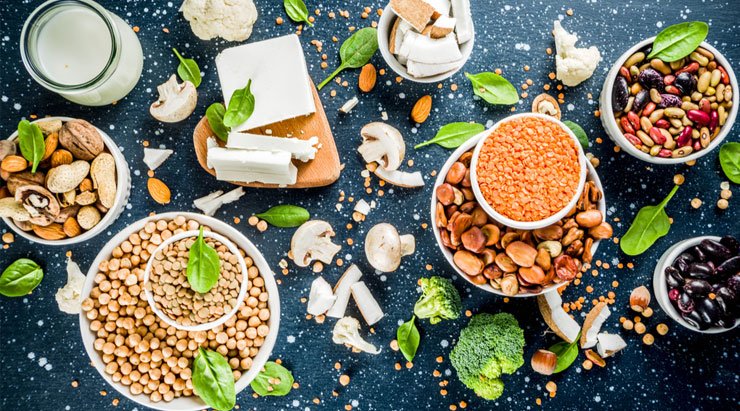
All amino acids are the building blocks of protein. Everything from our hair, skin, nails, and internal organs rely on proteins for growth and reconstruction. Protein themselves are made of amino acids. There are 20 amino acids that the human body needs for its survival. Twelve of these can be produced by our bodies, while the remaining 8 – essential amino acids- have to come from the food we eat. It is crucial to remember that the body needs both types of amino acids to be present in our system to produce the 12 “non-essential” amino acids. What this means for you is that any drastic changes in your diet can seriously and adversely impact primordial functions in the body.
Eating animal products is the easiest way to get all 20 amino acids. That means eating fish, chicken, beef, eggs, milk, or cheese. Other foods like legumes, grains, fruits, and nuts don’t have all 20 amino acids, but if you eat the right combination, you can get all you need. That is particularly important for strict vegetarians or vegans who don’t eat animal products like eggs.
A well-balanced Diet
Our food must contain all macronutrients like protein, carbohydrates, and fats and micronutrients like vitamins and minerals for a well-balanced diet. In this article, we will talk about protein requirements, how much protein a body needs, what are healthy protein sources, and what kind of protein diet should be part of your balanced diet.
Protein Requirement Calculator
You should have pondered protein requirements for the body, especially If you’re gearing yourself towards a healthy lifestyle – eating a more nutritious diet, working out a lot, or being a vegetarian. In contrast, a mathematical formula determines how much protein you should consume. Other primary factors guide you in choosing the protein quantity you should consume.
Let’s look at this mathematical formula that will tell you the exact protein requirements for an individual.
(Weight (in lbs.) / 2.2) x (0.8 –> 1.8) = Proteins in grams per day
Protein Requirement per Day
It is important to pay attention to the last part of the equation; less active or completely sedentary people should consume 0.8gm per kg of body. The more active you are, the higher your protein intake, even up to 2.2gm per kg of body.
Protein Requirement for Building Lean Muscles
Remember, if you eat animal products, you will most likely get sufficient protein. If you’re a vegetarian, on the other hand, then make sure you combine foods from the various food groups to guarantee that you’re getting all the Protein. Although protein is often said to be necessary to build muscle, unless you’re a professional bodybuilder, you don’t need to worry about increasing your protein intake. When you exercise a few times a week, your body can build muscle with regular consumption of protein diets.
Protein Requirement for a Pregnant Women
Conclusion:
For the growth of a healthy body, there is a need for a balanced diet. According to nutritionists, a healthy and balanced diet are two separate things. Eating a healthy diet doesn’t mean you are eating a well-balanced diet. Keeping you healthy is not an easy task throughout your entire life. You have to be aware of what type of food will play a key role in maintaining your health, how much energy you will get from a particular food, and what healthy ingredients are part of that food.